
ABIC Action: Supreme Court Affirms Birthright Citizenship, Protecting America’s Families and Economy
The U.S. Supreme Court struck down the administration’s executive order attempting to end birthright citizenship on Tuesday, reaffirming the 14th Amendment’s guarantee that children born on U.S. soil are American citizens.
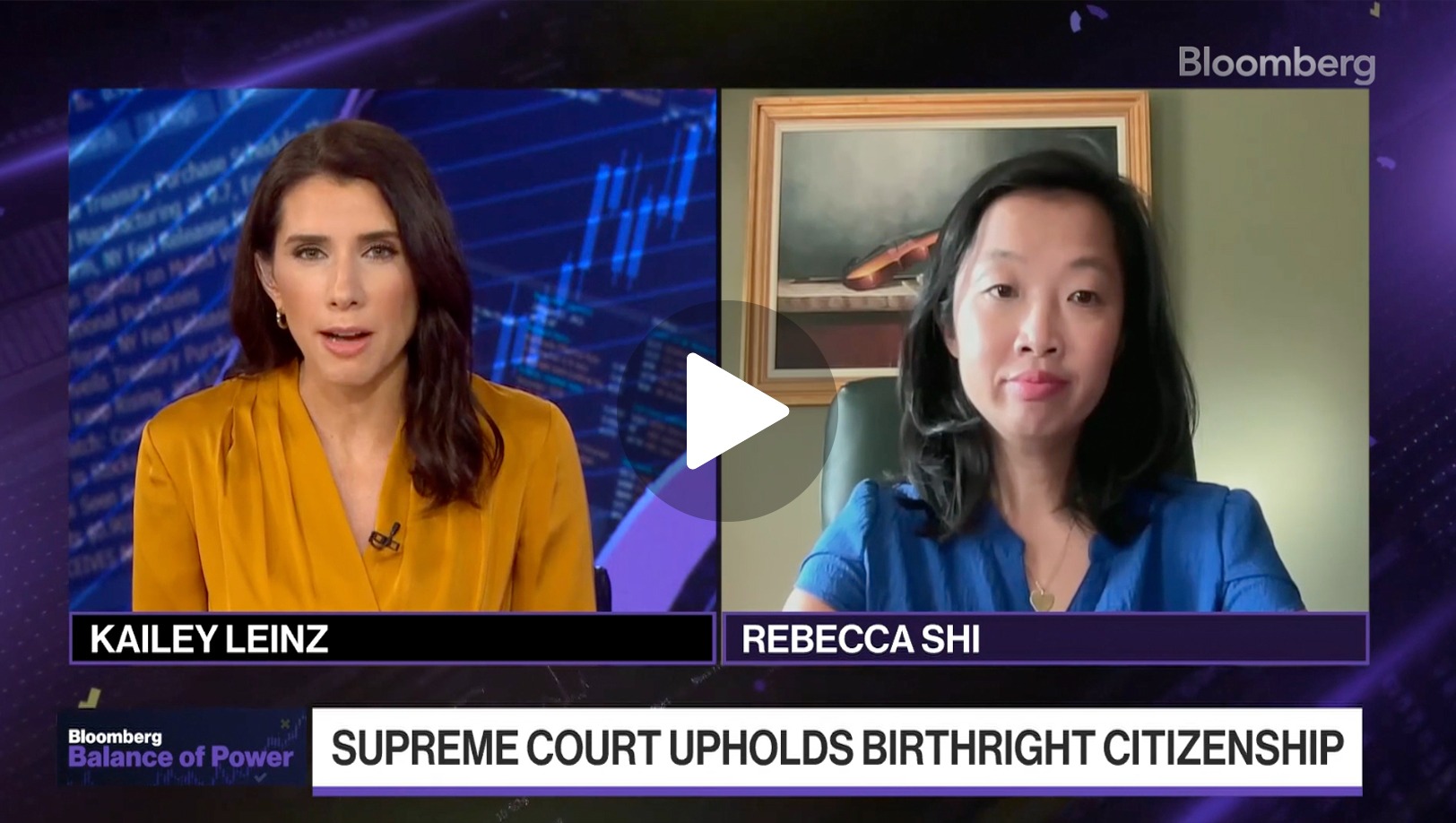
ABIC CEO Rebecca Shi joined Bloomberg’s “Balance of Power” to discuss the sweeping economic implications of this decision, watch the full interview here.

“Today’s decision affirms what the Constitution has long made clear: birthright citizenship is the steel scaffolding of our future economy, and beneficiaries born to immigrant parents are projected to contribute $7.7 trillion to our economy over the next several decades,” – Rebecca Shi, CEO
Comité de 100, a bipartisan coalition of over 200 Hispanic business, faith, and community leaders co-chaired by Massey Villarreal, Ramiro A. Cavazos, and Sam Sanchez, praised the ruling while sending a razor-sharp warning to Washington lawmakers ahead of a critical midterm cycle:
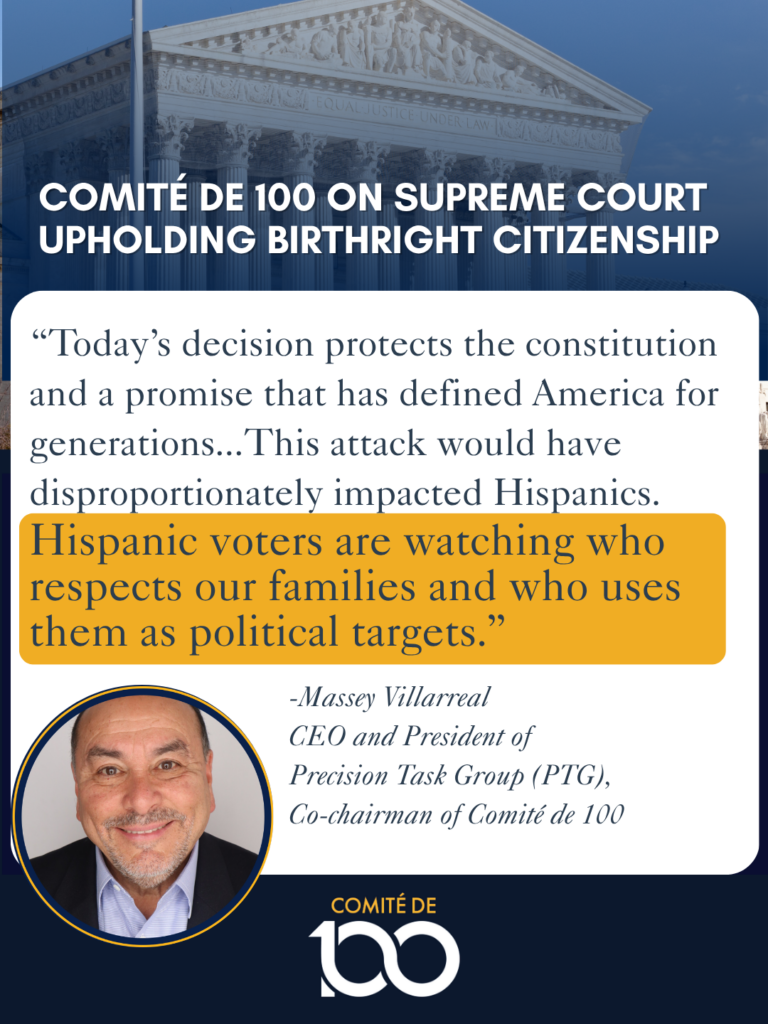
For the Hispanic business community, the court’s decision is tied directly to the nation’s future economic success. Ramiro A. Cavazos, President and CEO of the United States Hispanic Chamber of Commerce (USHCC), underscored the stakes for the economy:
“Attacks on birthright citizenship create uncertainty for millions of Hispanic Americans that create businesses, jobs, and power America’s economy. Upholding birthright citizenship is critical to the economic potential of this country.”
With the Supreme Court’s ruling window coming to a close, business leaders across the country continue their call to Congress to work together toward permanent and common-sense legislative solutions that protect the American workforce.
“Millions of Hispanic children will grow into the teachers, nurses, entrepreneurs, and service members who fuel our nation’s progress. It is time for leaders to end these disruptions and advance bipartisan solutions, such as the Dignity and Dream Acts,” said Sam Sanchez, CEO of Third Coast Hospitality.
Invite: Join ABIC Webinar Critical Briefing for Employers July 9th
Join us on Thursday, July 9 at 2:00 PM ET / 11:AM PT for an update on the political and legal state of play after the Supreme Court Decision’s on Haiti TPS:

You’ll hear concrete guidance to protect your staff, defend your operations, and learn how to advocate for permanent legislative solutions in the face of:
- TPS Crisis: 1.3 million workers face removal without immediate congressional action.
- DACA Threat: Deliberate renewal delays are pushing 520,000 DACA holders out of status, costing them their livelihoods and stripping employers of critical talent.
Button: Register for the webinar here.
More from the ABIC Network:
TPS Recipients, Employers and Communities Brace for Fallout of Supreme Court Ruling Clearing Path for End to TPS
Last week’s Supreme Court ruling has put the future of hundreds of thousands of critical workers, some who have lived in the U.S. for decades with TPS, in doubt. More than 350,000 Haitians and roughly 6,000 Syrians have TPS, but the Supreme Court ruling ultimately could affect immigrants from 17 countries whose citizens were safeguarded under TPS.
ABIC and our network were featured in multiple news outlets sharing the business community’s perspective on the ruling.
ABIC on NPR’s Weekend Edition:
Rebecca Shi, who heads a coalition of American employers, says the administration’s move is very destabilizing.
“These are vetted immigrants who arrive through legal pathways and hold valid, legal work authorizations, many for over a decade. Now, overnight, they faced forced removal from their communities, from the workforce. And these are ties that they have spent years building.”
Several ABIC members featured in The Bulwark’s reporting:
“We strongly disagree with terminating Haitian TPS,” Rebecca Shi, CEO of ABIC, said. “It’s economically destructive and morally wrong.”
Rob Liebreich, president and CEO of faith-based nonprofit Goodwin Living and an ABIC member, described his feeling of “sadness that more of our older adults who need support in years to come won’t get the care they need.”
Senior resident at Goodwin House Bailey’s Crossroads in Virginia, Rita Siebenaler was quoted from our ABIC Action press conference:
“This is not the way a civil society should treat its seniors or humanely treat immigrants to our country,” she said, urging Congress to press for extension of TPS.
And Linda Couch, the senior vice president of housing policy at Leading Age and an ABIC member, was quoted on the immediate impact to seniors and senior care facilities:
“People can lose their jobs overnight, and there is no workforce waiting in the wings that can replace these professionals,” Couch said.
ABIC Action and CEO Rebecca Shi were also quoted in Newsweek, Positive Aging and Crossroads Today.
Many outlets highlighted the potential negative impacts of the ruling on the U.S. economy, including:
- The New Republic: The Supreme Court Decision That Will Tear a Hole in the Economy
“The loss of workers and consumers will resonate in communities of all sizes throughout the country.” - Washington Post: Nursing homes, factory owners and immigrants brace for fallout from Supreme Court ruling
“News of the ruling devastated residents and staff at health care and elder care facilities across the country, since a large share of the Haitian immigrant population works in those industries.” - Bloomberg: High Court’s TPS Ruling Puts Workforces in Doubt for Employers
“The effects of this ruling will be felt by more than just those directly impacted – every worker, every community, and the entire economy will feel it,” said Milton Jones, president of the United Food and Commercial Workers International Union
Bipartisan Coalition Rolls Out Agricultural Workforce Reform Bill
House Agriculture Committee Chairman GT Thompson and a bipartisan coalition of 49 original co-sponsors recently introduced the Securing America’s Workforce Act (SAWA). The legislation seeks to modernize the H-2A visa program by expanding access to year-round agricultural labor, such as dairy farmers, streamlining the hiring process for employers, and providing legal work authorization for certain long-term agricultural workers already in the United States.
The bill comes at a time when labor shortages represent the most urgent problems facing U.S. agriculture. According to American Farm Bureau President Zippy Duvall, reduced labor supplies stemming from current immigration policies limit us from “being at the full potential production of food for our country.”

ABIC Agricultural Council formally endorses the Securing Agriculture’s Workforce Act.
The ABIC Agricultural Council released a statement calling the bill a major step in the right direction. The council noted that SAWA addresses long-overdue barriers faced by farmers by modernizing the H-2A visa program and expanding access to a year-round workforce. Crucially, it also fills a critical gap by giving undocumented agricultural workers a path to temporary legal status and work permits.
The agricultural labor crisis is starkly illustrated by recent data: according to the American Farm Bureau, in 2025, only 182 domestic applications were submitted for nearly 415,000 advertised agricultural positions.
Matt Teagarden, CEO of the Kansas Livestock Association (KLA), emphasized the around-the-clock nature of the industry and the need for stability:

“A stable workforce that farmers can rely on, one where workers feel secure in their status without fear, will provide real relief for our agricultural sector, farmers, and ranchers. This is a step forward that acknowledges what Americans already know: immigrants are essential to agriculture,” Teagarden said.
At yesterday’s House Small Business Committee hearing, entrepreneurs testified that federal immigration policy is harming local commerce and the national cost of living. ABIC Action submitted a statement for the record highlighting that small businesses drive 80.4% of national hiring, about 4 million hires monthly, with immigrants accounting for 24% of all U.S. entrepreneurs. Listen and watch testimony here.

The submitted data shows that immigrant entrepreneurs comprise 36.8% of employer businesses in accommodation and food services, and 46% of owners in transportation and warehousing. Collectively, these businesses contribute an estimated $1.3 trillion in annual sales.
News Briefing:
Texas Standard: ICE Focus Moving Beyond ‘Criminal’ Targets
According to ICE arrest records obtained through the Freedom of Information Act by the Deportation Data Project and analyzed by the Houston Chronicle, federal enforcement has increasingly focused on individuals whose only violations are civil immigration infractions, rather than serious criminal records.
The data shows that between February 2025 and February 2026, more than 38,000 people without criminal convictions or pending charges were arrested by ICE in Texas. According to Houston Chronicle reporter Julián Aguilar, this category, which ICE classifies as “other immigration violators”, accounted for more arrests in the state than individuals with existing criminal convictions or pending criminal charges.
Immigration attorneys cited in the report note that many of these arrests are occurring during routine, mandatory check-ins that are a formal part of the asylum process.
The Department of Homeland Security (DHS) disputes the implications of the data, stating that the figures are being presented in a misleading way. DHS maintains that nearly 70% of ICE arrests nationwide involve individuals with criminal histories, and suggests that some individuals classified as non-criminals may have committed offenses outside the United States that do not appear in domestic law enforcement records.
Bloomberg: DHS Advances Rule Nixing Automatic Renewal of Work Permits
The Trump administration is moving to permanently end automatic extensions of work permits for immigrants awaiting renewal, building on an interim rule that already took effect in October. If finalized, USCIS’s own backlogs could push thousands of asylum seekers, refugees, and other workers out of their jobs.
NPR: As Supreme Court expands Trump’s immigration power, experts warn of steeper U.S. population decline
The Supreme Court handed the Trump administration sweeping new immigration authority with the TPS and asylum rulings. Experts warn the timing is dangerous: for the first time since the Great Depression, the U.S. faces record-low birthrates and record-low immigration at once, with migration into the country projected to fall from 2.7 million in 2024 to as low as 300,000 this year. Economists say the fallout of fewer workers paying into Social Security, school closures, and stagnating populations even in low-immigration states like Iowa and Nebraska, could compound quickly. The Census Bureau is projecting a population loss exceeding 107 million by century’s end without robust immigration.
Perspectives:
Days before the nation’s 250th anniversary, the Editorial Board commented on a monumental session of immigration decisions in the U.S. Supreme Court. The Editorial Board strongly backed the Court’s 6–3 decision to strike down the executive challenge to birthright citizenship, but ultimately said the birthright ruling was a rare bright spot in an otherwise regressive judicial session. The board strongly condemned two other 6–3 decisions handed down last week, which allow the administration to strip TPS from hundreds of thousands of settled Haitians and Syrians.
The Editorial Board wrote that the U.S. desperately needs comprehensive legislative reform through Congress that simultaneously balances workforce needs, border security, family unity, and legal pathways to citizenship.
Get Involved
- Join one of ABIC’s Councils of 100 and let your voice be heard with your peers – sign up here. The Council of 100 is a coalition of top business leaders working to advance common-sense workforce solutions.
- Share your story: If your business is interested in engaging with the press as part of ABIC or amplifying your story on social media, take this quick survey to let us know your preferences.
- Work with us: ABIC is hiring! We are looking for a California State Director and Digital Manager to join our growing team. Learn more.
Always available: ABIC Employer Resources Folder
ABIC in the news. . .
- The Bulwark: Trump Lost on Birthright Citizenship. But He’s Winning the Immigration Wars. (6/30/26)
- Bloomberg: TPS Rulings Risk Deepening Labor Shortages (6/30/26)
- Positive Aging Sourcebook: Filling the Care Gap: Immigration, Workforce, and the Future of Senior Living (06/29/26)
- Newsweek: TPS Migrants Told Apply to Stay or Leave US, Offered More Than $2,000 Help (06/28/26)
- Crossroads Today: After Supreme Court’s TPS Decision, More Than a Million Immigrants Face Scramble to Stay in US (06/26/26)
- The Washington Post: Nursing Homes, Factory Owners and Immigrants Brace for Fallout from Supreme Court Ruling (06/26/26)
- Fox: SCOTUS allows Trump administration to end TPS (06/26/26)
- McKnights: Senior Living, ‘Confounding and heartbreaking’: Provider groups decry Supreme Court decision that could see the departure of immigrant workers (06/25/26)
- CNN: Supreme Court Gives Trump Major Wins on Two Immigration Cases (06/25/26)
- Milwaukee Journal Sentinel, Wisconsin dairy farms lack workers. This Trump visa change might help (06/25/26)
- ACOM: Slow Walking DACA Renewals Hurts Dreamers and the Economy (6/23/26)
- SAN: Why are DACA renewals taking up to six months? (6/22/26)
- Politico: DACA Renewal Delays Fuel Worries Trump is Quietly Undermining ‘Dreamers’ (6/21/26)
- Texas GOP Vote: Nation’s Top Scientists Endorse The Dignity Act (06/18/26)
- Dairy Agenda Today: ADC backs Ag Workforce reform proposed by Chairman Thompson (06/18/26)
- WBAY: Las Vegas Leaders Say DACA Processing Delays Threaten Nevada’s Workforce (06/15/26)
- 13 ABC: Las Vegas Leaders Say DACA Processing Delays Threaten Nevada’s Workforce (06/15/26)
- Fox 5 Las Vegas: Las Vegas Leaders say DACA Processing Delays Threaten Nevada’s Workforce (06/15/26)
- Politico: Business and Community Leaders Urge Congress to Expedite DACA Renewals and Cease Deportations of DACA Holders (06/15/26)
- LiveNow Fox: House Lawmakers Remarks on Housing Affordability (06/04/26)
- FOX 13 Tampa: ‘Dignity Act’ Targets Housing Affordability Crisis(06/04/26)
- FOX 30 Jacksonville: The Dignity Act and Housing Affordability (06/04/26)
- FOX 43 Harrisburg: Dignity Act and Housing Affordability (06/04/26)
- Forbes: America Is Shrinking Its Workforce At The Worst Possible Time (5/28/2026)