
With affordability and ICE cruelty as defining issues for voters heading into election day next Tuesday, ABIC’s new report examines how aggressive immigration enforcement is disrupting the workforce behind America’s food supply and adding pressure to already-high prices. Explore the full report.
The political stakes are clear: an October 2026 AP-NORC poll found that 84% of voters consider the cost of living one of the most important issues in their midterm vote.
ABIC’s report shows workplace raids, terminated legal protections and canceled work permits are contributing to labor shortages across farms, food processing and restaurants, driving up costs.
Key findings include:
- Food affordability concerns are real. Lettuce price is up 32%, whole milk up 9% and restaurant meals up 3.4%
- Enforcement is costing jobs. Nearly 700,000 jobs were lost in 2025 in U.S. cities targeted by ICE workplace raids, detentions and a broadening atmosphere of fear.
- Federal policy is destabilizing the workforce. TPS terminations, DACA renewal delays and outdated rules make it harder to hire and retain workers.
- Work permits people already hold are being canceled. More than one million people have lost TPS under the current administration.
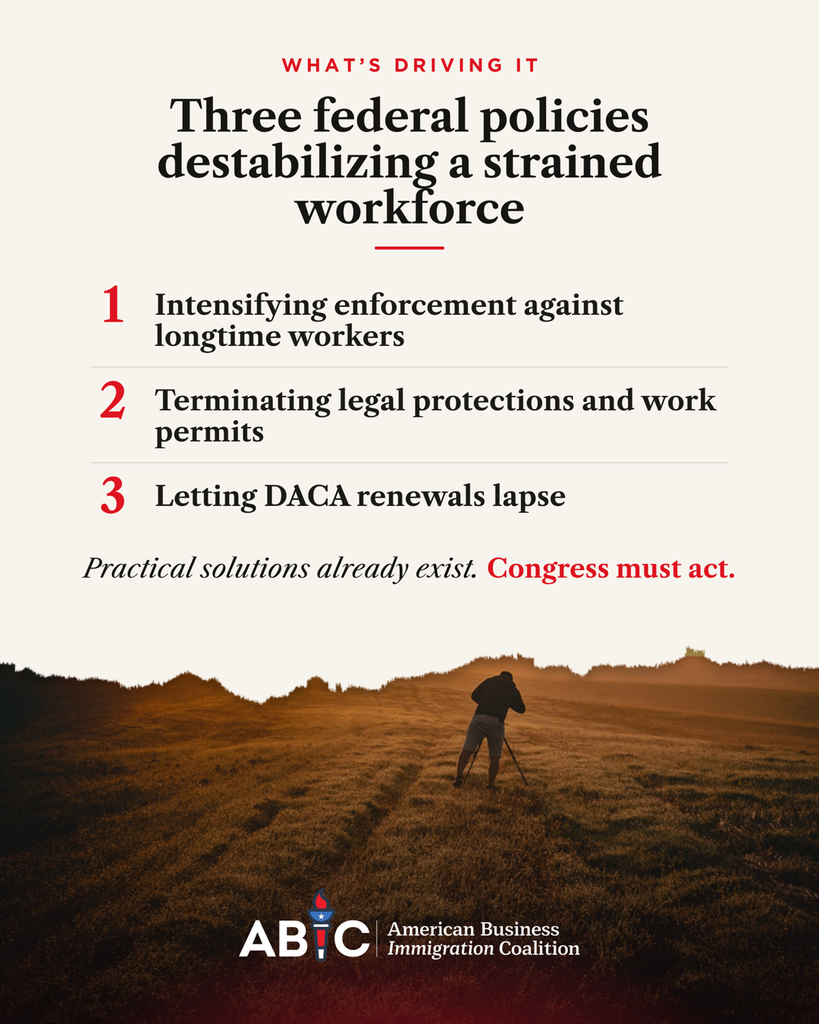
As families face mounting financial pressure, workforce disruptions can mean fewer workers to grow, process and serve food, while businesses struggle with staffing and lost customers.
Immigration solutions lower prices and voters are demanding lawmakers take action. Work permits and legal protections for long-term, law-abiding immigrants can help employers retain experienced workers and stabilize the food supply chain.
_________________________________________
ABIC invites you to join us for a Post-Election Analysis & Press Briefing on Friday, November 6th at 12 PM EST / 11 AM CST.
ABIC leadership and business leaders will share share:
- An analysis of the 2026 Midterm Election Results and what they say about support for work permits for long-term immigrants
- Our legislative priorities in the lame-duck congressional session starting November 9th.
- Opportunities for employers and business leaders to advance practical immigration solutions in their states.
Button: RSVP to our Post Election Analysis
_______
Insert image
ABIC CEO Rebecca Shi recently spoke on how immigration serves as a vital solution for workforce and affordability challenges at the NYC Jobs CEO Council. The event also featured prominent business leaders including Accenture CEO Julie Sweet, Robin Hood CEO Richard Buery Jr., Aon CEO Greg Case, and PSP Chairwoman and former Commerce Secretary Penny Pritzker.
Hispanic Voter Surge: Comité de 100 Midterm Watch:
Texas is already seeing high Latino-voter turnout, as backlash from aggressive enforcement is having an impact on races across the country, reports the Wall Street Journal, the LA Times, the AP and El Pais.
Latino voters in Texas’s Rio Grande Valley are increasingly frustrated with Trump over rising costs and aggressive immigration enforcement, and they are showing up. Hispanic voters in Texas are turning out at a rate of about 28.3%, up from 20.7% in 2022, they comprised 18% of early voters as of Sunday, 1 percentage point more than 2024 and 2 points above 2022. A recent WSJ poll found Latino voters favor Democrats for Congress 53% to 35%, while 68% disapprove of Trump’s job performance.
Former Trump supporters cite rising costs, worker shortages and immigration raids disrupting businesses. Homebuilder Benny Melendez, board member of the South Texas Builders Assoc., and ABIC member, voted for Trump in 2024, upset about inflation under the Biden administration and the border crisis he saw locally. Now, he regrets it after seeing aggressive immigration enforcement drag away workers, even those with proper paperwork.
The historic surge in Hispanic voters, driven by high prices and ICE cruelty, is happening across the country according to data from TargetEarly:
“Many Latinos are done with Trump. The shift is especially striking in Texas,” reports the LA Times.
Many Latino voters are increasingly prioritizing economic stability, humane immigration enforcement, and candidates who treat their communities with respect. Their support could influence control of Congress, the LA Times wrote, though many remain independent of either party and may split their votes across races.
“They are not just looking for what party to align with. They want to know that they can trust the person they’re voting for,” University of Houston political science professor Brandon Rottinghaus told El Pais.
The El Pais feature includes multiple voices from South Texas Builder’s Association, an ABIC member and references our work together speaking with lawmakers:
Home builder Mario Guerrero had grown so frustrated with immigration raids on contractors’ worksites across the state’s southern reach that he traveled to Washington, D.C. earlier this year to lobby for help from federal officials.
Construction, agriculture and healthcare have all been hard hit by aggressive enforcement and loss of legal work permits and pathways.
“Our cities and especially our industry are being really affected by ICE operations…Sooner than later, we will all feel the negative impact on our wallets,” Benny Melendez, a three time Trump supporter, South Texas Builders Assoc. and ABIC member, was quoted in the article from a social media video.
Trump’s immigration crackdown sparked a backlash that could boomerang in the midterm, reported the Associated Press. Voters are increasingly distinguishing between securing the border and the administration’s deportation tactics, creating political challenges for Republicans, the AP said.
Democrats are also adjusting their messaging to emphasize border security and removing criminals, while opposing excessive enforcement:
“We need commonsense immigration reform and when we get that it will drive down costs at the grocery store, isn’t that the whole point?” Blake Gendebien a farmer and Democratic Congressional candidate from NY said.
“Both political parties have failed us on this issue, Joe Biden failed us during his administration by not securing the border,” Texas Senate candidate James Talarico said. “I think we’ve got to get to a place where we reject the extremism on this issue in both parties and finally pass comprehensive immigration reform.”
__________
In Memoriam

We mourn the passing of civil rights icon Dolores Huerta. She was a relentless fighter for the undocumented farmworkers who feed our nation. Today, we honor her legacy by continuing the push for legal status and citizenship for Latinos and immigrants who power our economy.
We are also mourning one of our own: Comité de 100 leader Alma Aguilar, CEO of the Florida Mexican American Chamber of Commerce, passed away this week after a long fight against cancer.
“A life that inspired, empowered, and uplifted so many. A loving mother, a dedicated businesswoman, and a true leader in her community. Her kindness, strength, and vision will forever live in our hearts,” reads a dedication from her loved ones.
We are so thankful for her dedication to Comité, and for the time we were able to spend with her in this shared fight. [will insert CTA if we get a link for a fund or family donation link]
Comité de 100 is a coalition of prominent Mexican American and Latino business leaders from across the United States, dedicated to advocating for practical immigration solutions. Co-chairs leading the coalition are Massey Villarreal, CEO of Precision Task Group, Ramiro Cavazos, president of the U.S. Hispanic Chamber of Commerce, Sam Sanchez, CEO of Third Coast Hospitality, and Rev. Samuel Rodriguez, president and CEO of the National Hispanic Christian Leadership Conference.
_______
Perspectives
WSJ Opinion Letter: Immigration Enforcement Hurts the Economy
A veteran immigration attorney from Oklahoma, E. Vance Winningham, argues that current ICE tactics against long-term, noncriminal immigrants are already hitting the real economy. When workers lose authorization or are detained, farms, hospitals, builders, and small businesses lose labor, consumers pay higher prices, and taxpayers absorb safety-net costs.
He writes Congress has failed to align legal labor supply with demand.
“Removing essential labor without functional legal alternatives is not order. It is manufactured scarcity, and every American consumer will now begin paying the price.”
Get Involved
- Join one of ABIC’s Councils of 100 and let your voice be heard with your peers – sign up here. The Council of 100 is a coalition of top business leaders working to advance common-sense workforce solutions.
- Share your story: If your business is interested in engaging with the press as part of ABIC or amplifying your story on social media, take this quick survey to let us know your preferences.
- Work with us: ABIC is hiring! We are looking for a California State Director and Digital Manager to join our growing team. Learn more.