

Business Leaders Nationwide Join ABIC in Effort to Protect Salvadoran TPS Holders
This victory – though not yet permanent – was hard fought and the result of strategic coalition building led by TPS Alliance and ABIC
A month after the official decision deadline, the Trump administration has yet to decide whether to extend or revoke Temporary Protected Status (TPS) for roughly 2000,000 Salvadoran immigrants, the majority of whom have lived and worked in the U.S. for 25+ years, with a 90% labor participation.
ABIC brought together a broad coalition of business owners, faith leaders, labor and advocates together with our partners at the TPS Alliance to urge the Trump administration to end the uncertainty by extending the work permits for Salvadorans with TPS. This victory- though not yet permanent, was hard fought and the result of strategic coalition building led by TPS Alliance and ABIC.
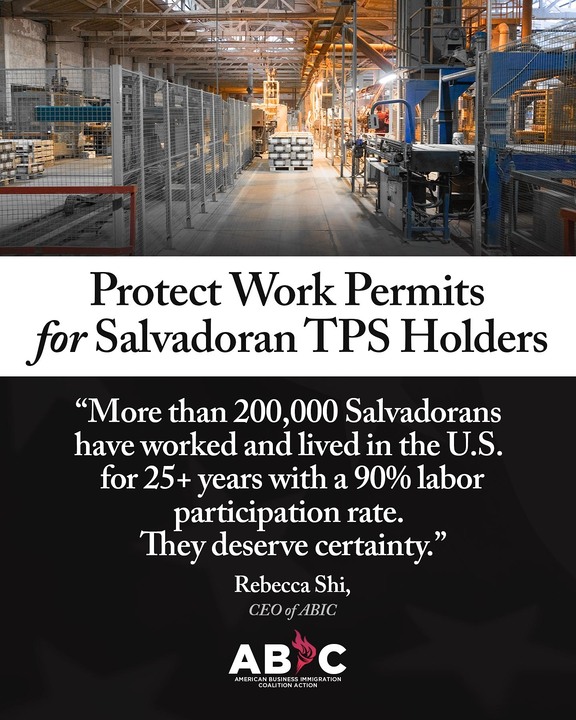
Salvadoran TPS holders across the country remain protected and authorized to work, for now, but the daily uncertainty has left hundreds of thousands of families and employers struggling to plan their lives and business operations.
“To maintain America’s global economic leadership, our immigration policies must offer stability and clarity to the employers and industries that drive our progress,” wrote the coalition in a letter to President Donald Trump and Homeland Security Secretary Markwayne Mullin, underscoring the economic stakes of stripping legal work authorization from people who have lived and worked in the United States for more than 25 years.
“We fully support a secure and orderly border to ensure public safety. We must also protect the economic foundation of our nation by stabilizing our existing, law-abiding workforce.”
The signatories include ABIC Board Chairman and former Arizona Republican state Sen. Bob Worsley, ABIC CEO Rebecca Shi, IBC Bank CEO Dennis Nixon, Florida Restaurant and Lodging Association President and CEO Carol Dover, Kansas Livestock Association CEO Matt Teagarden and Comité de 100 Co-chair Massey Villarreal. Small-business owners, chamber leaders, restaurateurs, farmers and employers from across the country also joined the appeal.
The signatories warn that ending TPS for El Salvador would compound ongoing labor shortages, raise recruitment and training costs and reduce productivity. For families, ending TPS for El Salvador would directly threaten the livelihoods of more than 150,000 U.S. citizen children who currently depend on their parents’ earnings.
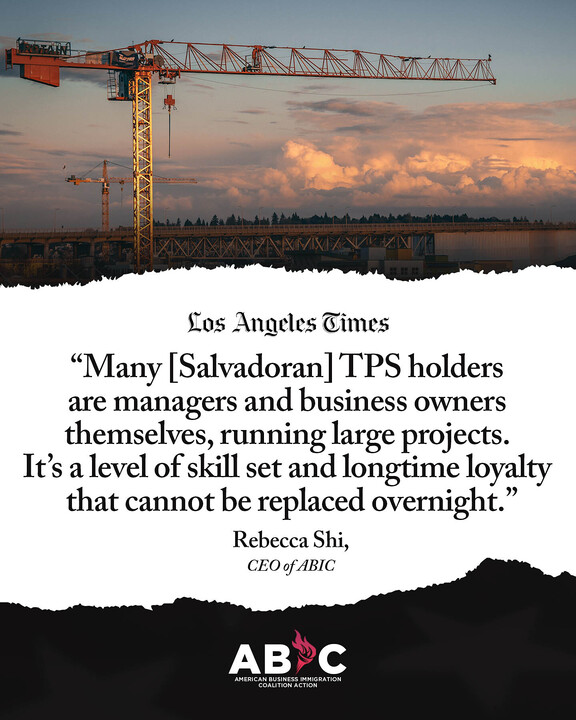
The Los Angeles Times reported the uncertainty is particularly significant in Washington, D.C., where the construction industry relies heavily on Salvadoran TPS holders.
Rebecca Shi, CEO of ABIC told the LAWhy hasn’t the Trump administration decided the fate of TPS for Salvadorans? – Los Angeles Times Times Salvadoran TPS workers are especially valuable because of the skills and experience they have built over decades in the construction industry, and that President Trump knows this personally because he’s been in the industry:
Roxy Mejia, political director of a local painters union, said contractors have pushed to preserve TPS because ending it would create a major labor shortage: “Even the contractors have lobbied with us to keep TPS extending, because they would lose a lot of manpower in this area.”
____________________________________________
Midterm Watch from Comite de 100
Polls Continue to Show Latino Voters Swinging Away from Trump and Republicans
A new NBC News/Telemundo poll finds that immigration enforcement is a major source of frustration among Latino voters, with two-thirds saying the Trump administration’s deportation policies have gone too far. The results mirror ABIC and AFU’s recent polling showing 75% of Latino voters in battleground states are more likely to support a candidate who backs work permits for long-term undocumented immigrants.
Overall, 69% of Latino voters in the new NBC/Telemundo poll disapprove of Trump’s handling of immigration, and Democrats hold advantages over Republicans on the issue. The findings, based on a survey of 800 registered Latino voters conducted September 21–28, 2026, also show how concerns about deportations, family and the economy are shaping views of the administration ahead of the November midterms.
The impact of the current aggressive immigration policies is hitting close to home for many voters: 31% of Latino voters say they or someone close to them has started carrying identification because of concerns about ICE enforcement, 27% know someone detained or deported by ICE in the past two years, and 18% say they or someone close to them has considered leaving the U.S. because of ICE concerns.
Republican pollster Micah Roberts noted that while Latino voters support some immigration enforcement, “the Latino electorate believes it’s gone way too far.”
Politico Playbook also reported this week on Trump’s cracking Latino coalition highlighting Equis Research polling showing the share of Latino voters citing immigration overreach as a concern doubled from 10% in May to 20% in August. Among Latino voters who supported Trump in 2024, 42% now say they regret or are disappointed by their vote. Nationally, Trump’s approval among Latino voters stood at 31%, while 63% disapproved, according to Equis’ August poll.

Valencia warned that Democrats can’t take Latino voters’ support for granted: “Democrats can’t be afraid to talk about securing the border, but that can’t be the only policy.”
In the Bloomberg opinion piece ‘Latino Voters Are the New Swing Voters’ Mary Ellen Klas wrote, “If Democrats win control of Congress in November, it will be in large part because the Latino voters President Donald Trump captured in historic numbers in 2024 have abandoned him. And if Democrats don’t act decisively on two fronts — the economy and immigration — these voters will be up for grabs again in 2028.” ABIC and AFU’s recent polling was featured in the piece, as well as multiple leaders from the Comité de 100 coalition calling for protections for long-term immigrants.
GOP Senators Warn That Trump Has Fumbled Immigration Issue
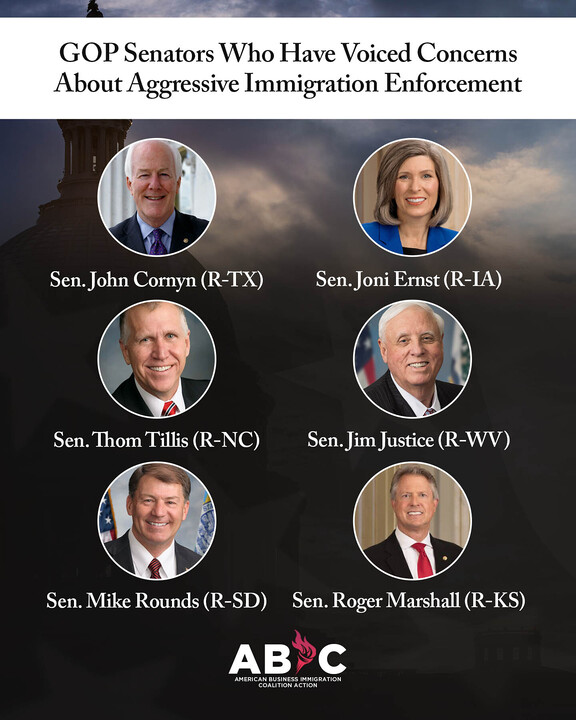
Republican senators are increasingly warning that President Trump’s aggressive mass-deportation policies have become a political liability, reports The Hill, alienating suburban and Hispanic voters and overshadowing his administration’s success in reducing illegal border crossings by more than 90%.
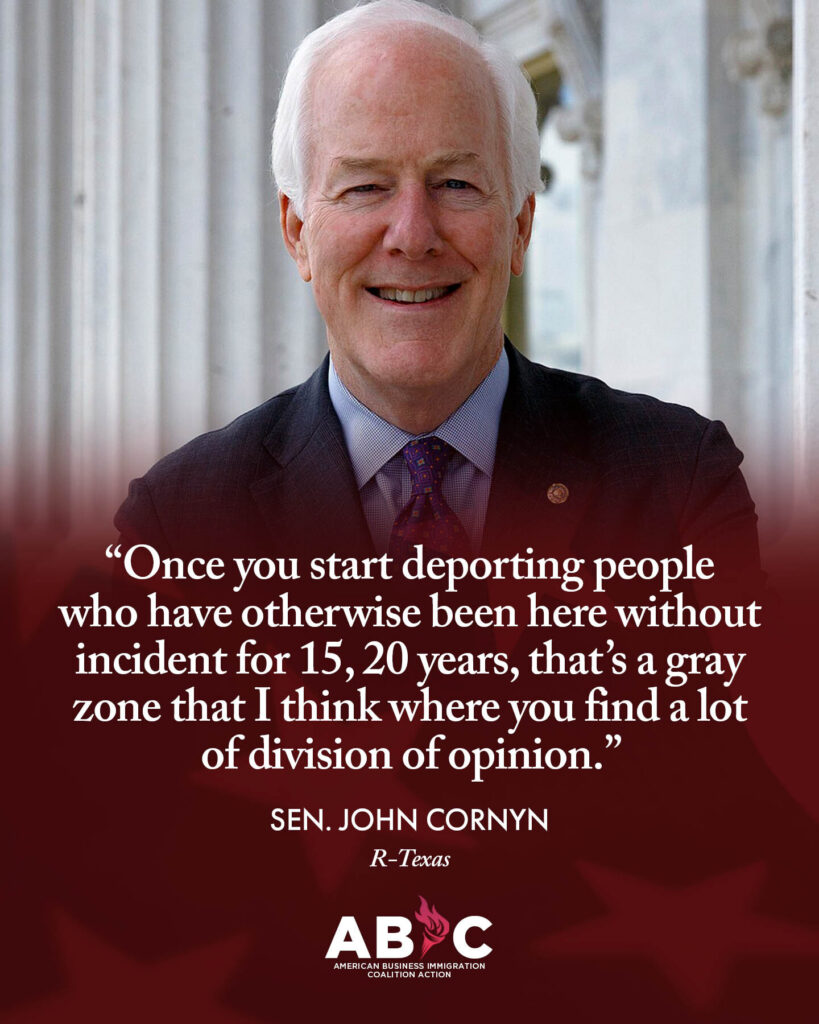
Sen. John Cornyn (R-TX) said mass deportations send “the wrong message.”
Sen. Thom Tillis (R-NC) called the approach both “politically dumb” and “immoral,” warning: “I would rather have 100 illegally present people go free than have that innocent person caught.”
“Instead of taking that win … we’ve completely masked that enormous success of securing the border, by overreaching and going too aggressively” after mass deportations, Tillis said.

Sen. Joni Ernst (R-IA) also raised the possibility of a more humane approach for long-term residents who contribute to their communities.
____________________________________________
Agriculture Council Advocates for SAWA (Securing Agriculture’s Workforce Act) to Address Farm Labor Crisis
Matt Teagarden, CEO of the Kansas Livestock Association and chair of the American Business Immigration Coalition’s Ag Council told Oklahoma Farm Report SAWA is critical to addressing America’s farm labor crisis and protecting the nation’s food supply. The legislation, introduced by House Agriculture Committee Chairman G.T. Thompson, would modernize the H-2A guest worker program to include year-round jobs and create a pathway for existing agricultural workers to obtain legal work authorization after vetting.
“What I would call the biggest problem in agriculture today, and that is the workforce needs and the inability to secure the workforce that we need in agriculture,” Teagarden said.

Teagarden emphasized that livestock operations, including feedyards, dairies and ranches, require workers year-round, not just seasonally.
“Multiple ag segments across the country have been very supportive—nearly unanimous support for this bill,” Teagarden noted.
Without reform, he cautioned, labor shortages could drive up grocery prices, increase reliance on imported food and disrupt families, businesses and rural communities. Recent immigration enforcement in southwest Kansas, he added, has already caused workers to stay home out of fear, contributing to lost wages, operational disruptions and beef processing delays.
____________________________________________
DACA Renewal Applicants Continue to Face Record Delays
Between September 2025 and June 30 of this year, the backlog of pending renewal applications has more than quadrupled for DACA to over 125,000. The delays have caused stress, uncertainty and in some cases losses of wages or jobs.
“You feel like you don’t have agency, like nothing that you do is good enough because it’s outside of your control,” said Juan Carlos Cerda, whose DACA renewal application took six months to process, causing him to take unpaid leave from his role as the Texas director for the American Business Immigration Coalition. “I had to pull back on spending and had to cut bills, things that were not necessary in order to make ends meet.”
The slowdown in processing is not unique to DACA. USCIS reports show that the backlog of work authorization applications for noncitizens across the board has increased by 60% from December 2024 to August 2026.
Get Involved
- Join one of ABIC’s Councils of 100 and let your voice be heard with your peers – sign up here. The Council of 100 is a coalition of top business leaders working to advance common-sense workforce solutions.
- Share your story: If your business is interested in engaging with the press as part of ABIC or amplifying your story on social media, take this quick survey to let us know your preferences.
- Work with us: ABIC is hiring! We are looking for a California State Director and Digital Manager to join our growing team. Learn more.
Always available: ABIC Employer Resources Folder
ABIC in the news. . .
- The Washington Post: With TPS in doubt for Salvadorans, businesses brace for turmoil (09/11/26)
- The Los Angeles Times: Confusion over protected status leaves employers and Salvadoran immigrants scrambling (09/10/26)
- The Gilmer Mirror: More than 100 organizations representing millions in the foodservice industry join Seat the Table, urge Congress to act on work permits and affordability. (09/10/26)
- Univision:Congressman García calls for maintaining TPS for Salvadorans: “They are people who work and pay their taxes”(09/09/26)
- More coverage: Univision, Fox Local, CW 39 Houston
- Newsweek: Trump Admin Leaves El Salvador TPS Status Unresolved (09/09/26)
- Politico: Behind the GOP convention: An immigration fight (09/08/26)
- HomeCare Magazine: Why Immigration Is a Key Staffing Solution (09/08/26)
- University of Illinois Chicago – Great Cities Institute: Hunkering Down: Immigration Enforcement’s Economic Cost (09/08/26)
- WABE (Atlanta’s NPR/PBS affiliate): Georgia’s elder care workforce faces impact as Haitians lose protected immigration status (09/08/26)
- America’s Voice: This Labor Day, Stand With Immigrant Workers (09/07/26)
- TexasGOPVote: What They Are Saying About Thompson’s Bipartisan Agricultural Labor Reform Bill (09/03/26)
- Central Oregon Daily News (USA Today Syndication): Could Trump Haitian immigrant crackdown hurt the economy? What to know (08/31/26)
- NPR: Trump’s economic policies hit Iran, Canada and U.S. workers (08/24/26)
- AG Bull: Odds for Farmer Aid and an Ag Labor Bill Before This Congress Runs Out (08/23/26)
- The Ford Foundation: Immigrant Talent Powers the American Economy (8/17/2026)
- Houston Public Media: TPS recipients hope a potential change of power in Congress provides relief from deportation (8/17/2026)
- McKnights Senior Living: ‘Surge of advocacy’ seeks to secure work authorization for former senior living and care employees (8/16/2026)
- San Antonio Current: Study: Trump’s mass deportations will cost Bexar County taxpayers more than $1.13 billion through 2028 (08/10/26)
- CNN: Ankle monitors, arrests and lost jobs: Inside the new realities many Haitians in the US are facing (08/09/26)
- South Bend Tribune: Immigrants play key role in U.S. economy, experts say (08/09/26)
- Bisnow: Senior Housing Sector Faces New Problem In Massachusetts: Deportations Of Employees (08/05/26)
- KSL: Former state senator, Lehi official, immigrant advocate recognized for their work with immigrants (08/05/26)
- Stuttgart Daily Leader: DACA backlog could affect Arkansas workforce, population (08/05/26)
- The Associated Press: AP Exclusive: Trump’s immigration crackdown has detained more than 50 military spouses and parents (08/05/26)
- The Economic Times: States may get power to sponsor worker visas in the US under new bipartisan bill (08/05/26)
- ABC News: ICE arrests hit record high in July as enforcement quietly ramps up (08/04/26)
- La Tribuna Hispana: Millions in losses and job shortages: the cost of ending TPS (08/04/26)
- Newsweek: New Visa Proposal Would Let States Bring in Migrant Workers (08/04/26)
- Kiowa County Press: Politics: 2026Talks – August 4, 2026 (08/04/26)
- Public News Service: DACA backlog could affect Arkansas workforce, population (08/04/26)
- Rio Grande Guardian: Villarreal: You cannot ask for our support while simultaneously attacking our families and targeting our workforce (08/03/26)
- Senator Mark Kelly’s Office: Kelly, Curtis Propose State-Sponsored Visa Pilot Program (08/03/26)
- The Philadelphia Inquirer: The U.S. faces financial losses as the Trump administration ends temporary protections for thousands of immigrants (08/01/26)
- Univision: Los operativos de ICE en la construcción tienen consecuencias: no hay mano de obra y los proyectos se retrasan y encarecen (07/29/26)
- ValleyCentral.com: From job sites to traffic stops, Valley builders say immigration enforcement is stalling construction (07/29/26)
- Texas Border Business: South Texas Builders Association Calls for Workforce Solutions at Immigration Forum (07/29/26)
- The Texas Tribune: South Texas Republican builders warn of voter backlash in November if aggressive ICE tactics continue (07/29/26)
- Cuba Headlines: ICE Raids Lead to Economic Losses of Up to $14 Billion, Academic Studies Reveal (07/28/26)
- CBS News: DACA renewal processing delays leave many across country in limbo (07/28/26)
- Noticias Telemundo: ¿Cuál es el impacto económico de las redadas de ICE? Esto muestran los estudios (07/28/26)
- News From The States: Haitian immigrants brace for end of protected status (07/28/26)
- Newsweek: Haitians Reveal Fear Over TPS End as Businesses Brace for Labor Shortages (07/28/26)
- NPR – Here & Now: TPS ends Monday for Haitians: What it means for them and their employers (07/27/26)
- McKnights Senior Living: ‘Equation is getting harder to solve’: Senior living providers navigate impending loss of immigrant staff (07/26/26)
- Public News Service: GA struggles to keep up with workforce demands as DACA renewals lag (07/22/26)
- The Daily Press: House judiciary panel won’t include farmworker visa changes in immigration package (07/21/26)
- The Washington Post: Trump immigration officials seek to mend frayed ties with business as arrests spike (07/19/26)
- Newsweek: TPS Update: DHS Warns of ‘Last Opportunity’ After Supreme Court Ruling (07/17/26)
- Greenfield Recorder: McGovern, 80 lawmakers urge extension of Temporary Protected Status for Salvadorans (07/16/26)
- The Florida Catholic: Haitians are ‘a people of hope’ despite SCOTUS TPS decision (07/15/26)
- Latin Times: Hundreds of Thousands of TPS Workers Face Job Losses as DHS Issues Employer Guidance (07/13/26)
- Financial Express: US employers told to fire thousands of foreign migrant workers over ‘temporary’ permits expiration: Report (07/13/26)
- Mwakilishi: Trump Extends Work Permits for Migrant Workers Hours Before Deadline (07/13/26)
- Newsweek: Republican Bill Seeks Major Overhaul of H-2A Visas (07/09/26)
- America’s Voice: More Than 350,000 Documented Immigrants Set To Be Stripped of Legal Status and Deported, Causing Ripple Effect In Communities (07/07/26)
- DRG News: American Business Immigration Coalition Agricultural Council Endorses the Securing Agriculture’s Workforce Act, Calls for Bipartisan Support (07/04/26)
- Sun Sentinel: What now? Florida hospitality employers seek guidance after US Supreme Court upholds TPS terminations (07/03/26)
- LegalClarity: DHS Immigration Raids Reversal: Fallout and Legal Challenges (07/01/26)