
On Wednesday, President Trump delivered a speech live from the White House where he discussed his achievements and agenda, including his immigration crackdown and his commitment to strengthening the economy and keeping prices down for consumers.
But in recent months, the Trump administration also has warned its own immigration policies could cause food prices to increase, and data shows mass deportations are worsening workforce shortages.
ABIC CEO Rebecca Shi responded to the speech by emphasizing the need for expanding work permits for law-abiding immigrant workers and citizenship for Dreamers.
“Without urgent action, labor gaps will continue driving up food and energy prices, making it harder for inflation to cool and threatening the stability of our economy and communities,” Shi said.
Legislation like the Dignity Act and the Dream Act is essential to ensuring the United States remains prosperous and competitive for years to come, Shi added. “By securing the workers our businesses need, we can keep prices down and ensure a stronger, more stable future for every American.”
More from the ABIC Network:
Bloomberg: Border Patrol Returns to Haunt Chicago’s Economy Before Holidays
Renewed immigration raids in Chicago ahead of the holidays are disrupting businesses and the local economy. Enforcement actions led by U.S. Border Patrol have cut sales and foot traffic in immigrant neighborhoods like Little Village, where sales tax revenue fell more than 30% and some businesses reported losses of up to 70%.
“[We saw] ICE walking down the street with machine guns and stuff. It was scaring people, it was really hurting restaurants.” -Sam Toia, President of the Illinois Restaurant Association and ABIC Member
Fear of deportation is driving both documented and undocumented immigrants out of the U.S. workforce, said ABIC CEO Rebecca Shi, causing labor shortages across key industries including agriculture, hospitality, construction, manufacturing, and elder care. Removing long-standing, law-abiding workers is straining critical sectors of the economy.
“Without [enough] labor, the demand for housing, for food, for care is still there. As a result, you just push up prices for all Americans.” -Rebecca Shi, CEO of ABIC
Milwaukee Groups Urge Trump Administration to Provide Work Permits For Long-Term, Law-Abiding Immigrants And Citizenship For Dreamers
Milwaukee business and community leaders urged the Trump Administration and Congress to grant work permits to long-term, law-abiding immigrants and provide a pathway to citizenship for Dreamers, citing workforce shortages and strong public support for reform. At a City Hall press conference organized by ABIC, business leaders highlighted bipartisan backing for work permits, citing a recent Marquette Law School poll showing 72% of Americans support granting permits to immigrants who have lived in the U.S. legally for at least five years and have no criminal record. Watch highlights here.
“Employers in industries such as construction, hospitality, manufacturing and childcare report persistent workforce shortages,” said Nelson Soler, president and CEO of the Latino Chamber of Commerce of Southeast Wisconsin. “These shortages slow economic growth.”
News Briefing
WSJ: Trump Administration Expands Travel Ban to Additional Countries
The administration significantly expanded its travel ban this week, imposing full or partial restrictions on citizens from 39 countries, plus Palestinian nationals, in the latest in Trump’s unprecedented crackdown on legal immigration. Five additional countries now face near-total bans, several others were upgraded from partial to full restrictions, and 15 more countries are subject to new limits on tourist and student visas.
The move follows a recent shooting of National Guard soldiers by an Afghan man in Washington and aligns with President Trump’s pledge to sharply restrict migration from what he called “third-world countries.” Beyond travel bans, the administration has paused asylum processing, reopened previously approved refugee and asylum cases, and introduced policies that could block green cards for people from banned countries even if they already live in the U.S.
Stateline: ICE Appears To Back Off Farm Raids As Trump Allows More Foreign Ag Workers
The Trump administration is easing restrictions for U.S. farmers to hire foreign agricultural workers while ICE appears to be scaling back farm workplace raids. Changes to the H-2A guest worker program will speed visa approvals, lower wages, and allow employers to charge for housing, helping farmers reduce labor costs amid workforce shortages.
“If you think farmers are making more money in these conditions, you’re wrong. They’re going broke,” said Lee Wicker, deputy director of the North Carolina Growers Association. Workers will take a pay cut under new guidelines and will have to pay for housing, but that may help farmers stave off bankruptcy, he said.
“I’m not saying the workers are going to be happy about this, but I think they’ll come back.”
Since June, ICE has conducted fewer agricultural raids, focusing enforcement elsewhere, although uncertainty and anxiety remains for farmworkers.
The Guardian: These migrants grow the U.S.’s Christmas trees. Trump’s wage cuts may keep them away.
North Carolina’s Christmas tree industry, reliant on H-2A guest workers from Mexico, faces strain from Trump-era wage cuts and immigration fears. Workers endure grueling, year-round labor, often in rural isolation, and wage reductions from the new H-2A guidelines of $5–$7 per hour may drive experienced laborers away.
“The immigration situation, and the new rules to lower wages, are both making many workers think hard about whether they will come back next year,” – Leticia Zavala, co-coordinator of El Futuro es Nuestro (It’s Our Future)
Farm owners warn losing skilled crews would hurt productivity and business. With North Carolina supplying much of the U.S. Christmas tree market, labor shortages could disrupt production and local economies.
“We have some local people that come to work for us, but they usually don’t last any length of time,” said Renee Beutell, President of Wolf Creek Tree Farm.
Economic Policy Institute: Trump’s Deportation Plans Threaten 400,000 Direct Care Jobs Helping Seniors and Others
Trump’s mass deportation plans could eliminate nearly 400,000 direct care jobs, threatening in-home support for older adults and people with disabilities. Because immigrants make up a large share of the direct care workforce, increased enforcement would sharply reduce available caregivers, forcing families to fill gaps themselves.
Research shows that aggressive immigration enforcement shrinks the direct care sector, and deporting 4 million people over four years could severely disrupt home- and community-based care, reducing employer demand for both immigrant and U.S.-born workers:
Pew Research Center: More Americans Say the Trump Administration is Doing ‘Too Much’ To Deport Immigrants in the U.S. Illegally
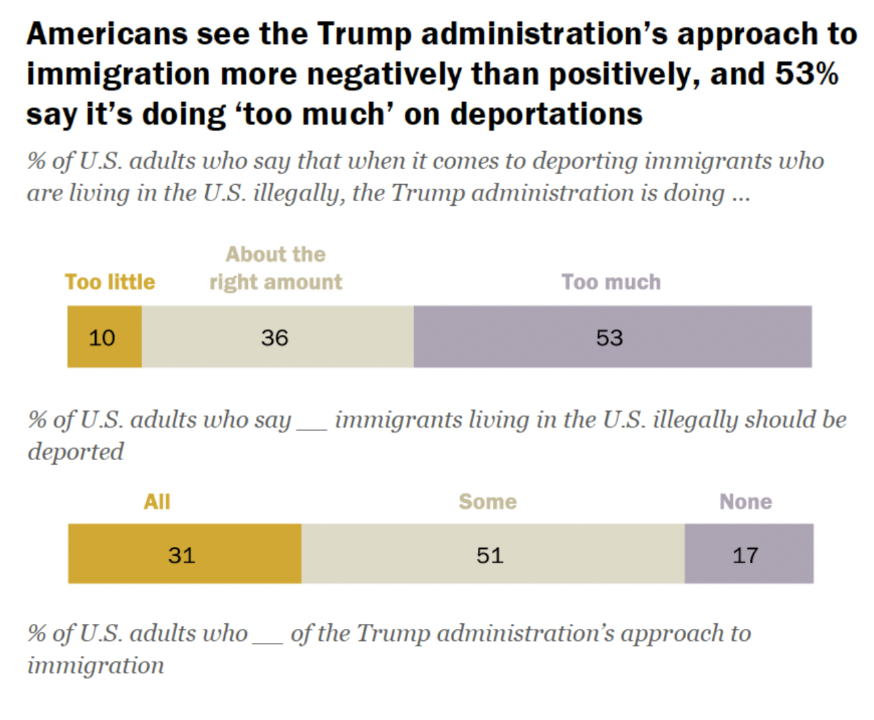
A growing majority of Americans say the Trump administration is doing too much to deport immigrants living in the U.S. illegally, according to a December 2025 Pew Research Center survey. About 53% now hold this view, up from 44% in March, while half of adults disapprove of the administration’s overall immigration approach.
At the same time, most Americans still support deporting at least some undocumented immigrants.
Marketplace: Why The Fed is Thinking About Immigration
Federal Reserve Chair Jay Powell’s latest presser included the usual talking points on hiring sentiment and the unemployment rate, but also included immigration. That’s because the current administration’s immigration policies are complicating Fed measures of labor market health.
“The current immigration policy is not just reducing labor supply, it’s also reducing how many people employers want to hire,” said Wendy Edelberg, a senior fellow at the Brookings Institution.
The Hill, Opinion: Why Is The Government Arresting the People it Wants to Legalize?
Daniel H. Weiss, former Principal Deputy Chief Immigration Judge overseeing the nation’s 74 immigration courts, writes that arresting immigrants who are actively applying for lawful permanent residence, including spouses of U.S. citizens and long-term residents with clean records, undermines the government’s stated goal of targeting serious criminals. He argues these arrests do not improve public safety and instead clog already overburdened immigration courts.
“Prioritizing arrests of green-card applicants and courthouse attendees…drains resources, slows the process for everyone, and punishes people for following the law.” – Daniel H. Weiss, Former Principal Deputy Chief Immigration Judge
Weiss warns this approach diverts attention from genuine public safety threats and discourages immigrants from engaging with lawful immigration processes.
Enforcement News:
The Hill: DHS Changing Immigration Enforcement Tactics Amid Negative Polling
The Department of Homeland Security plans to scale back highly visible immigration raids and shift toward more targeted enforcement amid growing public backlash. According to reports, also published in Fox News, Border Patrol teams will focus on specific individuals, particularly those convicted of serious crimes, rather than conducting large, publicized sweeps at workplaces or public locations.
The tactical shift follows negative polling on President Trump’s immigration crackdown. Despite the reported change, DHS says some large-scale efforts, including an ongoing operation in New Orleans, will continue.
CBS News: Trump’s Immigration Policies Are Hurting Minneapolis Small Businesses, Owners Say
Small business owners in Minneapolis say increased immigration enforcement under the Trump administration is devastating local commerce, as fear of ICE arrests keeps residents at home. Shops along Lake Street report drastic drops in foot traffic, with some businesses shutting down and others seeing sales fall to just 10–15% of normal levels.
City leaders and business owners warn the impact feels worse than the pandemic, noting that even legally employed workers and customers are afraid to go out, leaving thousands of families reliant on food assistance and threatening the survival of neighborhood businesses.
Immigration Enforcement Transforms Oregon’s Most Latino City As Fear Empties Businesses And Rattles Residents
Immigration enforcement has emptied businesses and battered the local economy in Woodburn, Oregon’s most Latino city, as fear keeps residents at home and workers off the job. City officials declared a state of emergency, citing an economic and humanitarian crisis, as arrests disrupt the workforce, deter shoppers, and threaten the survival of small businesses that anchor Woodburn’s economy.
“I’m most scared for my parents,” said a 17-year-old High School senior, whom The Oregonian/OregonLive is not naming to avoid putting his farmworker parents at risk. “I don’t know what’s going to happen. My parents can be taken tomorrow while I’m at school.”
Businesses Say City Could See Financial Crisis If Immigration Crackdown Continues Across New Orleans
Business owners in New Orleans warn that the ongoing immigration crackdown could push the city toward a financial crisis as staffing shortages worsen ahead of the holidays. Under Operation “Catahoula Crunch,” about 350 people have been arrested, including workers who business owners say were legally employed.
Construction and landscaping companies report losing long-time employees, forcing owners to take on more work, delay projects, and brace for higher costs.
“Now we are starting to have a labor shortage. That will increase the price of homes. And dramatically decrease the number of customers coming through the door,” said Shane, who runs a local roofing and siding company.
Publishing note: Thank you for your support and engagement with Know this Now and ABIC in 2025. Our next edition will be sent out the first week of January 2026.
Get Involved
- Join one of ABIC’s Councils of 100 and let your voice be heard with your peers – sign up here. The Council of 100 is a coalition of top business leaders working to advance common-sense workforce solutions.
- Share your story: If your business is interested in engaging with the press as part of ABIC or amplifying your story on social media, take this quick survey to let us know your preferences.
- We’re hiring! ABIC is looking for a National Field Director to help lead our national campaigns. Learn more and apply here.
Always available: ABIC Employer Resources Folder
ABIC in the news. . .
- Bloomberg: Border Patrol Returns to Haunt Chicago’s Economy Before Holidays (12/17/25)
- Madison 365: Milwaukee groups urge Trump Administration to provide work permits for long-term, law-abiding immigrants and citizenship for Dreamers (12/17/25)
- Stateline: More Industries Want Trump’s Help Hiring Immigrant Labor (12/03/25)
- Washington Examiner: Where Illegal Immigrants Find Work in the U.S. (11/24/25)
- Civic Media: Wisconsin Farmers Keep the Christmas Tree Industry Growing (11/18/25)
- Utah Business: 20 In Their 20’s (11/19/25)
- MarketWatch: The MarketWatch 25- The 25 people impacting your wallet (11/10/25)
- Politico: ICE tactics worry Republicans too (11/10/25)
- Sacramento Business Journal: Opinion: California business leaders must be vocal and active in pursuit of immigration reform (11/10/2025)
- Chicago Sun-Times: Business and civic leaders say ICE actions harming Chicago’s economy (11/07/25)
- ABC7 Chicago: Chicago business, civic and faith leaders join together to call for end to immigration raids (11/07/25)
- The Gazette: Iowa businesses brace for impact from changing immigration policies, enforcement (10/26/25)
- Hoodline: Senator Ruben Gallego Advocates Pragmatic Immigration Reform to American Business Leaders in Arizona (10/24/25)
- Representative Maria Elvira Salazar Press Release: Bipartisan Push: Reps. Salazar and Tom Suozzi Join Business Leaders to Highlight Urgent Immigration and Workforce Solutions (10/24/25)
- McKnights Senior Living: Modernize immigration system, provide legal status for law-abiding workers, providers urge (10/23/25)
- La Cronica: Vacantes 8 millones de empleos en EU por las deportaciones, alertan empresarios (10/23/25)
- KXAN: Report: Immigration crackdown likely slowing Texas job growth (10/23/25)
- Politico Inside Congress: Senators start getting stir-crazy (10/23/25) –
- Bloomberg Government: Farmers Warn Trump of $5 Billion Hit Without More Migrant Visas (10/22/25)
- El Pais: Over 100 business leaders go to Congress to warn about the labor shortage caused by deportations (10/22/25)
- Senator Dick Durbin Press Release: Durbin Meets with American Business Immigration Coalition to Discuss Dreamers, DACA, and Essential Workers (10/22/25) –
- Senator Ruben Gallego Press Release: Gallego Speaks on Immigration Reform at American Business Immigration Coalition (10/21/25)
- Mundo Now: Negocios latinos bajo presión por políticas migratorias de Trump (10/20/25)
- ABC News: Family farm in Idaho faces worker shortage as Trump administration immigration raids escalate (10/16/25)
- Newsweek: Texas Republican Speaks Out Against Deportations (10/11/25)
- Newsweek:Businesses Sound Alarm on Urgent Labor Shortages Amid Immigration Crackdown (10/14/25)
- Newsweek: Trump Admin Issues Warning on ICE Raids Impacting Farms, Offers Compromise (10/14/25)
Brownfield Ag News: Farm and business coalition pushes immigration reform to retain skilled ag workers (10/13/25) - Syndicated in WCMY/93.5 FM & 1430 AM: Farm and business coalition pushes immigration reform to retain skilled ag workers (10/13/25)
- Dairy News Today: Dairy Labor Crisis Flares: Industry Demands Immediate Visa Reform (10/13/25)
- InsideWis: From an unlikely source, a suggested change in immigration rules (10/10/25)
- Ag Information Network: Farmer Sentiment Up Slightly and Dairy Industry Urges Labor Reform (10/9/25)
- WisPolitics: DC Wrap: Wisconsin lawmakers trade barbs over which party bears shutdown responsibility (10/9/25)
- WisBusiness: Dairy group, Van Orden call for immigration law change to help farms (10/8/25)
- WisPolitics: Wisconsin Dairy Coalition: Wisconsin lawmaker joined dairy leaders in call for year-round ag workforce visa reform at World Dairy Expo (10/7/25)
- Edge Dairy Farmer Cooperative: Edge Dairy Cooperative calls for immigration reform at World Dairy Expo (10/7/25)
KFGO: Coalition calls for permits for agricultural workers (10/7/25) - Barn Media: NAFB’s National Ag News (10/7/25)
- AgProud: Legislation introduced to reform immigration for year-round agricultural workforce (10/7/25)